



Let me tell you something that might sting a little. A dangerous illusion is spreading through boardrooms today.
Organizations believe they are secure because they have invested in EDR. CrowdStrike, Microsoft Defender, or SentinelOne. They have dashboards. Alerts. Telemetry. Threat hunts. AI-assisted detections. SOC workflows.
And yet, breaches keep accelerating. Healthcare systems. Educational platforms. Retail ecosystems. Electoral systems. Cloud-native enterprises.
Different industries. Different geographies. Same outcome. Every single company that made headlines this year for a devastating breach? They had an EDR, too.
Because the problem is no longer “detection”.
The problem is survivability.
According to the 2026 CrowdStrike Global Threat Report, the average eCrime breakout time in 2025 dropped to just 29 minutes, a 65% increase in speed from the previous year. Driven by AI-enabled, malware-free attacks, the fastest recorded breakout occurred in only 27 seconds.
That is barely enough time for your security analyst to read and understand why something went from green to red.
Let that settle for a moment.
In May 2026, CISA launched the CI Fortify initiative, urging critical infrastructure organizations to ensure that essential operations can survive cyberattacks.
That language matters.
Not prevention. Survival.
Being Unaffected.
Being Breach Ready.
The strategic mindset in cybersecurity is changing before our eyes.
The question is no longer whether we can stop every attack, but whether we can keep the business functioning when under attack. Yes, you read it right — when, not if.
That is the foundation of Breach Readiness.
And this is precisely why EDR and microsegmentation must converge.
EDR Alone Cannot Solve This Problem
CrowdStrike. Microsoft Defender. SentinelOne.
These are all exceptional platforms.
They provide:
- Detection
- Behavioral analytics
- Threat intelligence
- Endpoint telemetry
- Automated response
But EDR fundamentally operates as a visibility and response system. It tells you what is happening, where it is happening, and how the breach is proliferating.
Detection is not containment. Response is not survivability.
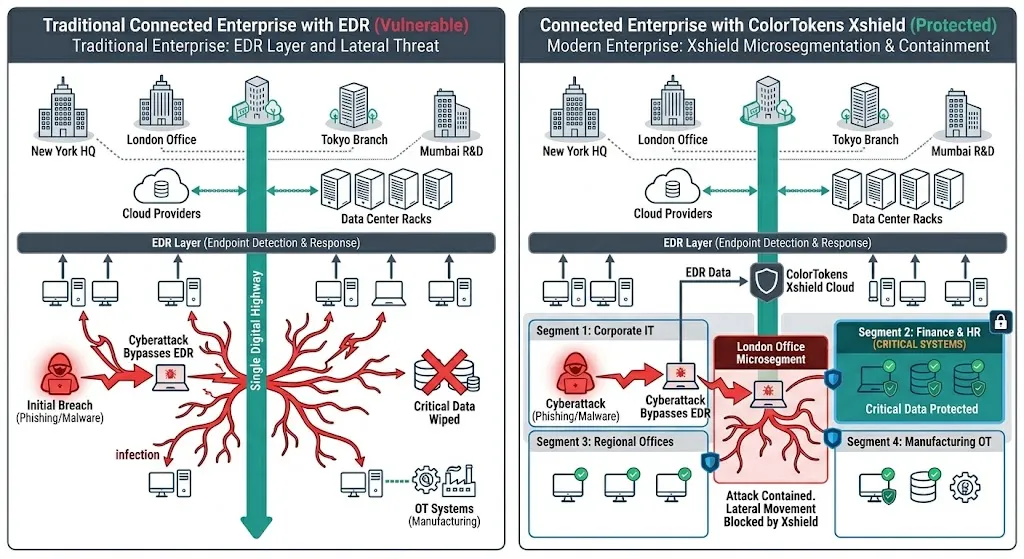
When an attacker bypasses your EDR (eventually they will, because nation-state actors and sophisticated ransomware groups have entire teams dedicated to EDR evasion), the adversary lands on a single endpoint, establishes a foothold, and then moves laterally across the entire network.
Your EDR raises an alert. Maybe it even kills the initial process. But the adversary is already three hops away, in a segment of your network where they can operate freely, because your endpoints are connected by a network designed for connectivity, not containment.
This is the gap. This is the chasm between “we have an EDR” and “we are breach ready.”
Once they can move laterally, they traverse from a compromised workstation to a critical server. Once they find your crown jewels, they exfiltrate. And then they act. They used to encrypt to extort.
But something changed in 2025. Attackers realized that people weren’t paying. And in 2026, they have reverted to wiping data on their way out. Ransomware is beginning to take on its initial form, Wiperware. More egregious, and significantly more dangerous. If you do not have a backup, you are looking at business loss. Ask Nike and Stryker. They have been through the pain.
This is where ColorTokens Xshield changes the equation.
Think of EDR as your nervous system.
It detects pain.
Then Xshield is your immune system.
It isolates infection before the body collapses.
Separately, they are useful. Together, they become transformative.
What Breach Ready Actually Means
Breach readiness is not something you buy. It is a business posture. It is your ability to answer three critical questions, without hesitation, when the pressure is on:
- Can I make it difficult for attackers to navigate my digital environment?
- Can I contain lateral movement before it reaches critical assets?
- Can I ensure that my critical digital systems are unaffected?
This is the age of AI. Mythos and Accenture’s recent XBOW acquisition have clearly demonstrated to the world that the future of cyber resilience must confront the reality that attacks will have to contend not only with relentless, complex, and devious cyberattacks but also with unprecedented machine speed.
To operationalize breach readiness, you need microsegmentation that works in the real world.
At speeds hitherto unforeseen, the kind you can deploy in hours or days, not months, and that integrates with the EDR you already own, making it smarter and more accurate.
Where Xshield Comes In — and Why It Changes the Math
This is where ColorTokens’ Xshield enters the conversation, and why it matters specifically for organizations running CrowdStrike, Microsoft Defender, or SentinelOne.
Xshield does not replace your EDR. It completes it.
Here is how:
1. Deep EDR Integration
Xshield integrates natively with CrowdStrike, Microsoft Defender, and SentinelOne. It ingests telemetry from your existing EDR, correlates it with network-level context, and uses that intelligence to inform segmentation policy. Your EDR detects the threat. Xshield contains it at the network level.
Xshield reduces the attack surface, and EDR becomes sharper because almost all signals are now relevant, thanks to fewer false positives. Xshield stops lateral movement, and suddenly that obscure RDP traffic becomes malicious.
EDR becomes smarter.
2. AI-Powered Breach Readiness
The reason most microsegmentation projects fail is not technology complexity. It is the effort needed to map application flows, understand dependencies, and write policies manually across thousands of endpoints and workloads… it takes months. Sometimes years. And by the time you’re done, the environment has changed. And then there is the context of the digital environment, and how the communications can be altered to defend against cyberattacks.
Xshield’s AI capabilities automatically discover application flows and dependencies, then generate segmentation policies based on actual behavior, not guesswork. What used to take a team of engineers six months can now be accomplished in hours. The AI doesn’t just accelerate deployment; it also adapts policies to the digital environment.
Xshield also adapts defensive maneuvers to suit changes in the digital landscape.
3. Quarantining at the Speed of Attack
When an EDR detects a compromised endpoint, Xshield can automatically quarantine the affected segment, not the entire network, while allowing critical business flows to operate “unaffected”. This is exactly what CISA’s guidance calls for.
This means that enterprises can plan for and achieve a Minimum Viable Digital Enterprise.
And that assures business stakeholders that the digital business can be trusted to operate “unaffected” even during the most unprecedented, unforeseen cyberattacks. Regular publication of successful business continuity exercises further assures the market that the enterprise can recover the “affected” business on time with Minimum Acceptable Material Impact.
The Adoption Timeline That Should Surprise You
Here is what typically stops organizations from pursuing breach readiness: the assumption that it is a 12–18 month transformation project.
It isn’t. Not anymore.
With Xshield’s AI-driven approach and existing EDR integration, organizations running CrowdStrike, Microsoft Defender, or SentinelOne can:
- Week 1–2: Deploy Xshield sensors and begin AI-driven discovery of application flows and dependencies
- Week 2–4: Auto-generate and simulate microsegmentation policies based on discovered behavior
- Week 4–6: Enforce initial segmentation policies and establish automated isolation playbooks triggered by EDR alerts
- Ongoing: Continuous AI-driven policy optimization and breach readiness validation
Six weeks. From EDR-only to breach-ready with automated containment.
That is not a future state. That is achievable right now, with the EDR you already have.
The Question Every CEO, CIO, and CISO Must Answer
Every breach I mentioned at the start of this article — the Canvas breach, the Alberta voter leak, Atrium Health Navicent, Coupang Taiwan, TrustedVolumes — every single one of those organizations believed they were prepared. They had security tools. They had teams. They had processes.
They were not breach-ready. And the consequences played out in public.
So here is the question:
If an adversary bypassed your EDR at 2:00 AM on a Sunday and began moving laterally through your network, how long would it take to contain them — and would you have to shut down critical operations to do it?
If you cannot answer that question with specificity and confidence, you are not breach-ready.
Not yet.
Your Call to Action
This is not a theoretical exercise. The adversaries are not waiting. CISA’s guidance on survivability is operational direction grounded in the reality that breaches are inevitable, and timely containment is the difference between an incident and a catastrophe.
To CEOs: Your board will ask about breach readiness. Answer with evidence, not assurances. A Breach Readiness Impact Assessment gives you the evidence.
To CIOs: Your infrastructure’s resilience depends on the ability to isolate and recover without a wholesale shutdown. Understand the gap between detection and containment in your environment.
To CISOs: Your EDR is necessary but insufficient. You know this. The question is whether you have the architectural layer that turns detection into automated containment at network speed.
The usual cybersecurity assessment takes days.
Begin your breach readiness journey with a Breach Readiness Impact Assessment. It is free, non-intrusive, and is done in hours. And the insights will reshape your security strategy for years.
Understand, in concrete terms, what would happen if your EDR were bypassed today. Map the lateral movement paths an adversary could exploit. Identify which critical assets are unprotected by segmentation. Quantify the business impact of an uncontained breach versus the rapid recovery that microsegmentation enables.
The assessment takes days. The insights will reshape your security strategy for years.
The breaches are coming. The only question is whether you’ll be ready when yours arrives.
Talk to a ColorTokens breach readiness expert and see how Xshield turns the EDR you already own into an automated breach-readiness fabric.