




In my years as a network security engineer, I was often asked the question: “What is the difference between macrosegmentation and microsegmentation?” Both are components of a robust cyber defense strategy, but they serve distinct purposes within a Zero Trust architecture.
Understanding Macrosegmentation
Macrosegmentation refers to the creation of well-defined network zones, grouping devices by shared characteristics such as:
- Location: Corporate, data center, cloud, or remote branch
- Asset type: Servers vs. endpoints
- Business service: Sales, support, finance, HR
This architecture is typically enforced using physical or virtual routers, switches, and firewalls. A common implementation method is through VLANs (Virtual Local Area Networks), which allow network administrators to logically organize devices into zones.
By defining these zones, organizations can control North-South traffic—that is, traffic moving between external and internal networks, such as web requests, emails, and file downloads. This traffic is routed through layer-three devices and is subject to inspection via firewalls, ACLs (Access Control List), IDS/IPS (Intrusion Detection System/Intrusion Prevention System), malware scanning, and TLS (Transport Layer Security) inspection.
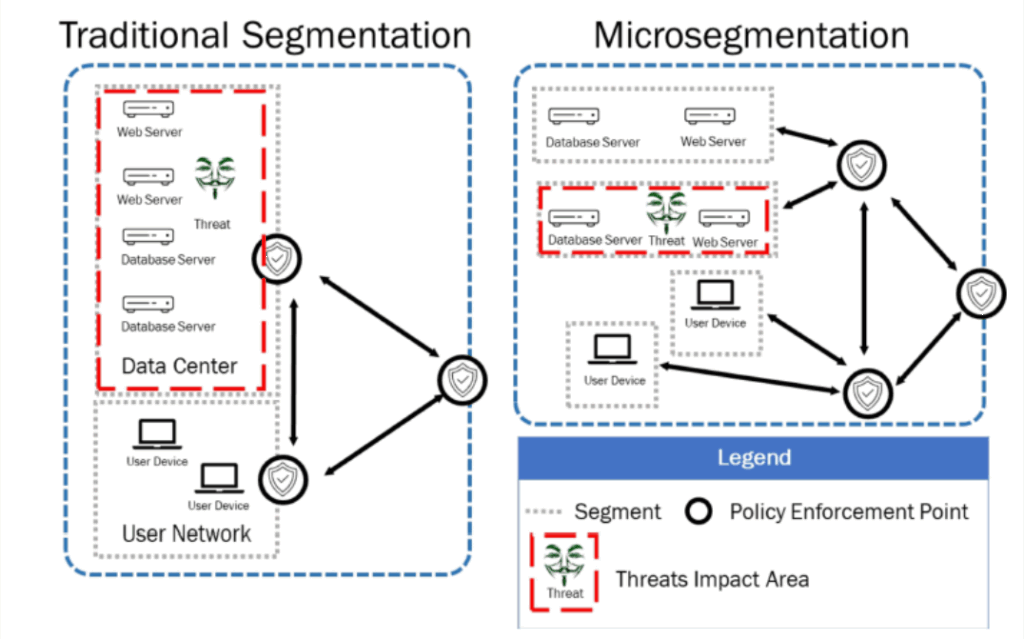
CISA just released a new publication, The Journey to Zero Trust: Microsegmentation in Zero Trust, Part One, Introduction and Planning, July 29, 2025. In it, they describe the difference between macrosegmentation (which they call “Traditional” segmentation) and microsegmentation. They graphically describe the difference using the figure below:
Limitations of Macrosegmentation
While macrosegmentation helps reduce exposure to external threats, it lacks the granularity needed to control East-West traffic, or lateral communications within the same network zone. This leaves organizations vulnerable to internal threats that exploit host-to-host communications. For example, if a single device in a VLAN is compromised, the attacker can potentially move laterally to other devices within that VLAN—bypassing North-South defenses entirely. It begs the question: if you choose to use macrosegmentation alone, are you willing to surrender all the assets in the large segment to a ransomware or malware attack, if one of the assets is compromised?
Gartner considers macrosegmentation a “traditional” or first-level segmentation approach, laying the groundwork for deeper security models. In their report Implementing Segmentation for Zero Trust Networking, January 2024, they describe the limitations of macrosegmentation in protecting your enterprise landscape:
“Macrosegmentation has its limitations because it only focuses on north-south traffic, which is traffic that goes from the client to the server. As data comes from outside the network, network segmentation is able to examine and filter it. However, if malicious activity is happening within the network, it could go undetected with traditional segmentation.”
Get Small: Transition to Microsegmentation
This is where microsegmentation becomes vital. It allows much more granular controls to stop unauthorized lateral movement, while allowing valid business processes to proceed.
Attackers gain an initial breach of the perimeter defenses using one of the thousands of attack methods available: phishing, social engineering, stolen credentials, software vulnerabilities, and many others. Once inside, they aim to move laterally to locate your critical systems and sensitive data. Then they exfiltrate data, disrupt operations, or deploy ransomware. Microsegmentation blocks this movement. It enforces strict, identity-aware policies right at the workload level, regardless of the underlying network. Gartner defines it as:
“The ability to put a security service between any two workloads in your infrastructure, whether those workloads are in the same domain or half the world away from each other.”
Microsegmentation enables traffic controls between every asset within a segment and can tightly control user-to-workload access as well. Since the controls are enforced right at the host level, microsegmentation can stop a break-out from the initial compromised asset. This capability is critical for a sound cyber defense strategy that is prepared for the inevitable breach of your perimeter defenses and makes you able to survive it.
Access Report | ColorTokens Named a Leader in the Forrester Wave™ Microsegmentation Report
Microsegmentation Implementation Strategies
1. Visualize Your Environment
Begin with visibility. Use tools to map how assets communicate internally and externally—covering IT, OT/IoT, containers, and cloud infrastructure. Include:
- IPs, ports, protocols, and processes
- Automated tagging of workloads
- Dependency mapping between services
2. Define Zero Trust Policies
Rather than writing granular, application-specific policies (which are hard to scale), define policies based on common attack vectors. For example:
- Allow RDP (TCP 3389) or SSH (TCP 22) access only from bastion hosts
- Block peer-to-peer communications between endpoints
- These measures eliminate critical lateral movement pathways.
3. Segment Core Services
Apply Zero Trust controls to key infrastructure:
- AD (Active Directory), DHCP (Dynamic Host Configuration Protocol), DNS (Domain Name System)
- NTP (Network Time Protocol), web servers, mail servers
Limit access to only what is explicitly required. This reduces the blast radius if a breach occurs.
Access Report | Compare the top 15 microsegmentation solutions in this GigaOm Radar report. Get insights to make smarter, faster, and more confident investment decisions.
Real-World Use Case
Imagine an attacker compromises a finance server. In a macrosegmented environment, they may move laterally to the HR server unchecked. With microsegmentation, lateral movement is blocked at the workload level—containing the threat.
Conclusion: Achieving Breach Readiness
Zero Trust isn’t just a philosophy—it’s a layered, actionable strategy. By combining macrosegmentation (zone-level defense) with microsegmentation (workload-level control), you build a resilient environment that can:
- Visualize and segment all communications
- Control both north-south traffic and east-west lateral movement
- Contain breaches before they become crises
Implementing microsegmentation moves your organization closer to being truly Breach-Ready. To speak with our expert solutions team about how you can protect your enterprise environment with microsegmentation, schedule a discussion here.